
For wedding planners, event decorators, rental companies, and floral wholesalers, flowers are more than decoration. They affect the event style, setup time, project cost, storage planning, and final profit.
Fresh flowers are beautiful, but they are not always easy to manage for large weddings or repeated event projects. Fresh flower prices can be affected by season, transportation and storage require extra care, and last-minute damage may create pressure for the entire event team.
This is why more event businesses are adding wholesale artificial wedding flowers to their product inventory. High-quality artificial flowers can be prepared in advance, used for different wedding themes, and stored for future projects.
For B2B buyers, artificial wedding flowers are not only decorative products. They can also become long-term event inventory.
This guide explains how to buy artificial wedding flowers in bulk, what product types to consider, how to check quality, and what to confirm before placing a bulk order.
What Are Wholesale Artificial Wedding Flowers?
Wholesale artificial wedding flowers are bulk faux floral products used for professional weddings and event decoration. Common buyers include wedding planners, event decorators, rental companies, hotels, banquet halls, wholesalers, and floral studios.
Unlike small retail purchases, wholesale buying focuses more on product consistency, repeat orders, packaging methods, shipping costs, customization ability, and long-term use value.
A retail buyer may only care whether one bouquet looks beautiful. A B2B buyer needs to consider more practical questions:
Will the color remain consistent in bulk orders?
Are the flowers strong enough for repeated transport and setup?
Is the packaging suitable for warehouse storage?
Can the supplier customize colors or sizes?
What is the real cost after shipping?
Can the product be reused for multiple events?
These questions are important because event businesses need products that look good, arrive safely, and perform well in real projects.
Why Do Event Businesses Buy Artificial Wedding Flowers in Bulk?
Artificial wedding flowers may not be suitable for every event, but they offer clear advantages for companies that manage multiple weddings or rental projects.
The first advantage is better cost control. Fresh flowers need to be purchased again for every event. Artificial flowers require an upfront investment, but they can be reused for multiple projects if they are stored and handled properly.
The second advantage is easier preparation. Many artificial floral products can be prepared in the warehouse before the event, helping reduce pressure during short venue setup windows.
The third advantage is more stable color and style. Fresh flower colors may be affected by season and supply. Artificial flowers allow decorators to build a fixed product catalog, so clients can see products that are closer to the final delivered result.
Artificial flowers are also suitable for large installations, such as flower walls, wedding arches, ceiling flowers, and stage backdrops. These products usually require a full and dense floral look. If fresh flowers are used, the cost can be high and the setup time can be tight. Artificial flowers are easier to transport, install, and reuse.
For many event companies, the real value comes from long-term reuse. If you are comparing fresh flowers and faux flowers from a cost perspective, this guide on fresh vs artificial flowers for event businesses can help you understand the difference more clearly.
Main Types of Artificial Wedding Flowers for Bulk Orders
Artificial Flower Walls and Backdrops
Flower walls are widely used for wedding ceremony backdrops, photo areas, sweetheart table backgrounds, hotel events, bridal showers, and commercial displays.
Common wholesale styles include solid-color flower walls, mixed flower walls, ombré flower walls, greenery walls, and feather flower walls.
For B2B buyers, it is important to understand the backing structure before placing an order. Artificial flower walls usually come with two common backing types: plastic grid backing and fabric backing.
Plastic grid flower walls are usually quoted by panel size. A common panel size is 60 × 40 cm. These panels can be connected together to create a larger backdrop.
Fabric-back flower walls are usually quoted by square meter. Fabric-back flower walls can often be rolled up for easier storage and transport, which is useful for rental companies and event decorators.
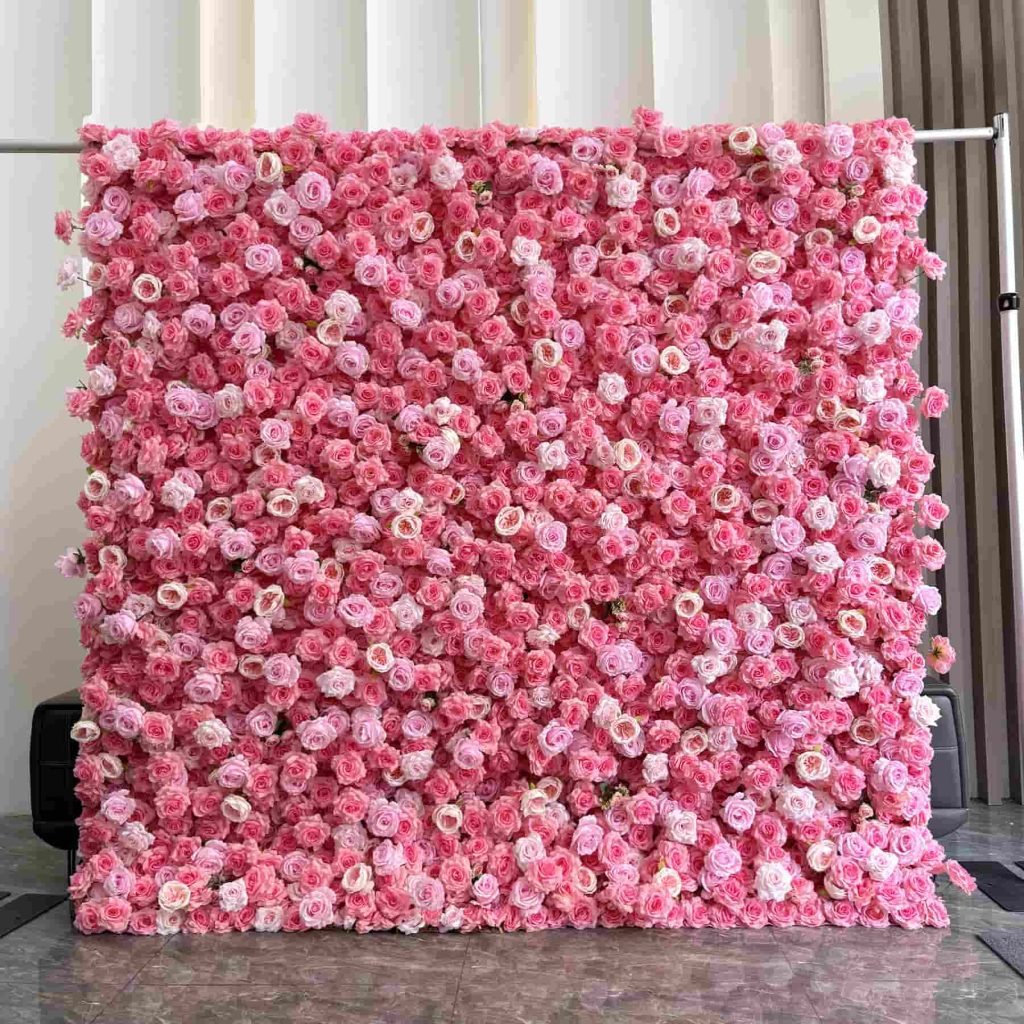
Common wedding backdrop sizes include 1.5 × 1.5 m, 2 × 2 m, 2.4 × 2.4 m, and 3 × 3 m. For larger events, buyers may need several panels or sections to create a wider background.
When choosing flower walls, buyers should confirm the size, backing type, flower density, installation method, carton size, and shipping volume. These details can affect both the product cost and the final delivered cost.
Flower walls are one of the most common products in wedding and event decoration. Before placing a bulk order, it is helpful to understand different artificial flower wall options, including backing types, common sizes, flower density, and packaging methods.
Artificial Wedding Arches
Artificial wedding arches are commonly used for ceremony areas, entrances, stages, and outdoor wedding setups. Popular styles include round arches, square arches, crescent arches, horn-shaped arches, and heart-shaped floral arches.
For event decorators and rental companies, arches are valuable because they are often one of the most visible focal points in wedding photos. They can also be combined with draping fabric, candles, aisle flowers, or flower walls to create a complete wedding scene.
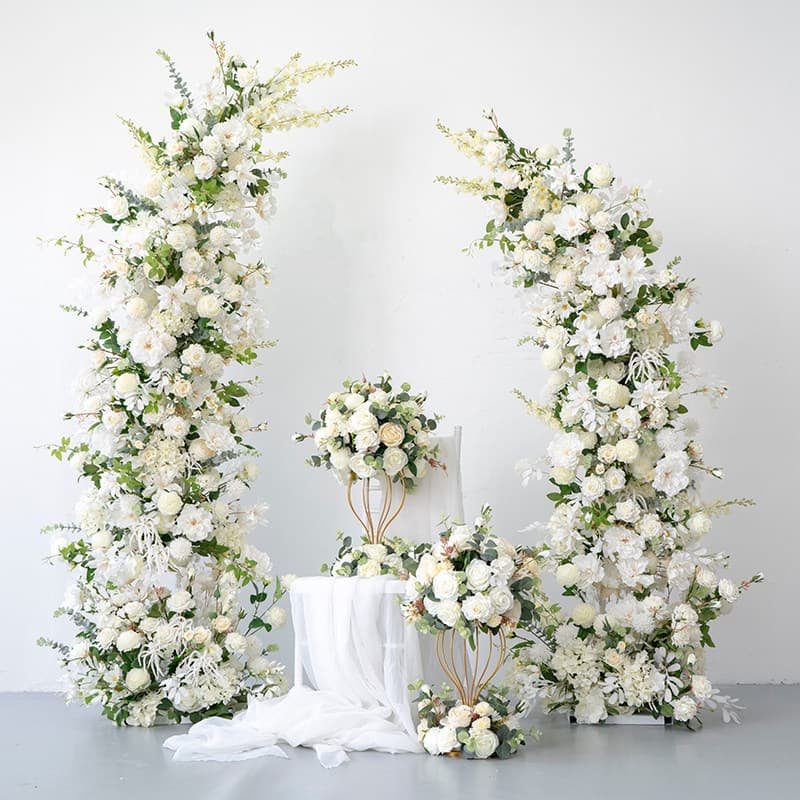
When buying artificial flower arches in bulk, buyers should confirm whether the arrangement is easy to install, whether the flowers are firmly attached, and whether the size fits common arch frames. Arch sizes vary by shape, such as 1.9 + 2.3 m, 1.6 + 1.9 m, or 2.6 m high × 2.4 m wide.
Packaging is also important. For example, one artificial flower arch set with sizes of about 1.9 m and 2.3 m can be packed in a carton of about 60 × 40 × 60 cm, with a weight of about 5.6 kg. This type of data helps buyers estimate storage space and shipping costs before placing an order.
Wedding arches are often the main visual focus of the ceremony area. If you are building rental inventory, choosing the right artificial wedding flower arches can help you create more flexible packages for different event styles.
Table Centerpieces and Floral Arrangements
Artificial table centerpieces are suitable for banquet halls, wedding receptions, hotel events, and rental packages. Common products include low table centerpieces, tall centerpieces, flower balls, main table flowers, and long floral runners.
For event companies, table flowers are often purchased in sets. This makes color consistency and inventory planning very important. One wedding may need 10, 20, or even more arrangements in the same style.
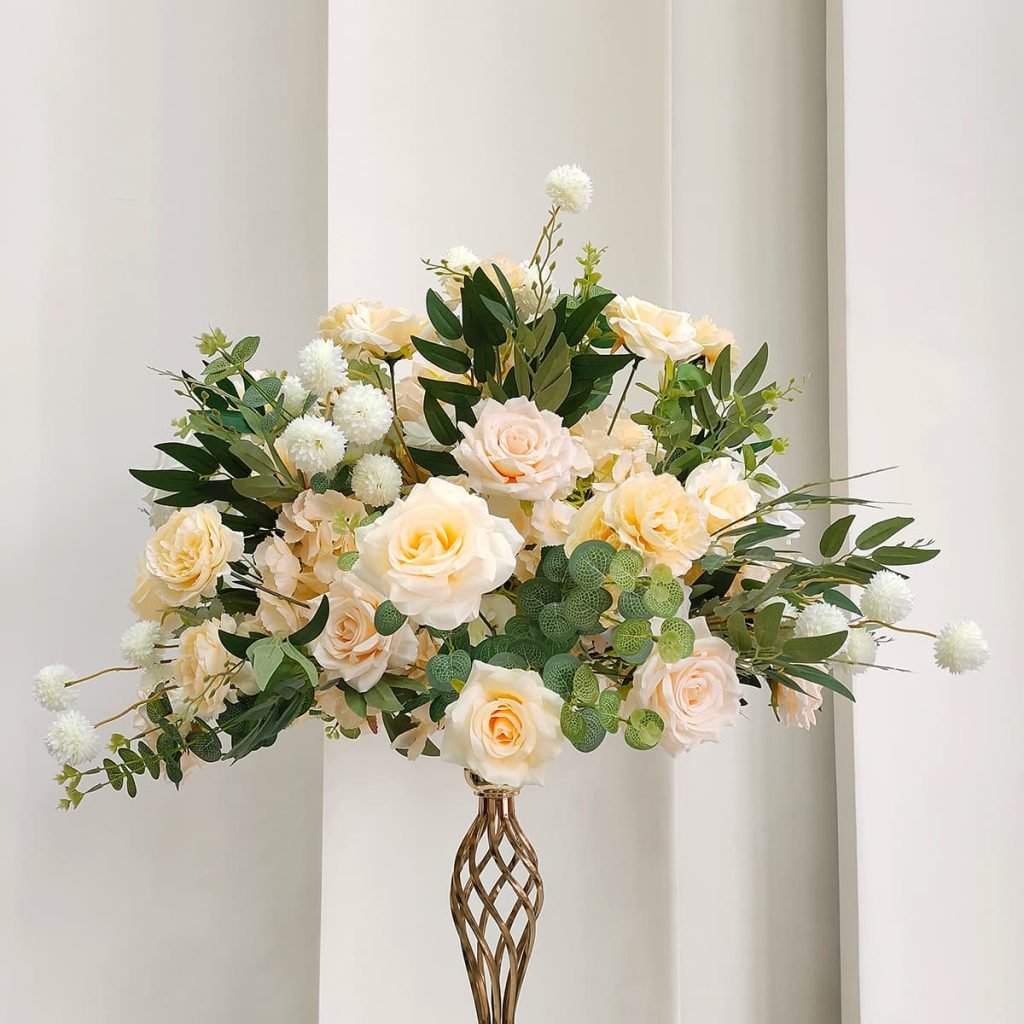
Before placing a bulk order, buyers should confirm the size, height, flower fullness, base structure, and packaging method. Table centerpieces should be easy to place on tables and stable enough for event use.
Flower ball diameters commonly include 40 cm, 50 cm, 60 cm, 70 cm, 80 cm, and 100 cm. Floral runner sizes may include 160 × 40 cm, 200 × 35 cm, 160 × 25 cm, and 100 × 35 cm.
Aisle Flowers and Chair Flowers
Aisle flowers, chair flowers, and pew flowers help create a complete wedding ceremony area. They are usually smaller than arches and flower walls, but they are often needed in larger quantities.
These products are useful for wedding planners who want to build a complete matching package. For example, one wedding theme may include a bridal bouquet, bridesmaid bouquets, arch flowers, aisle flowers, and table centerpieces in the same color palette.
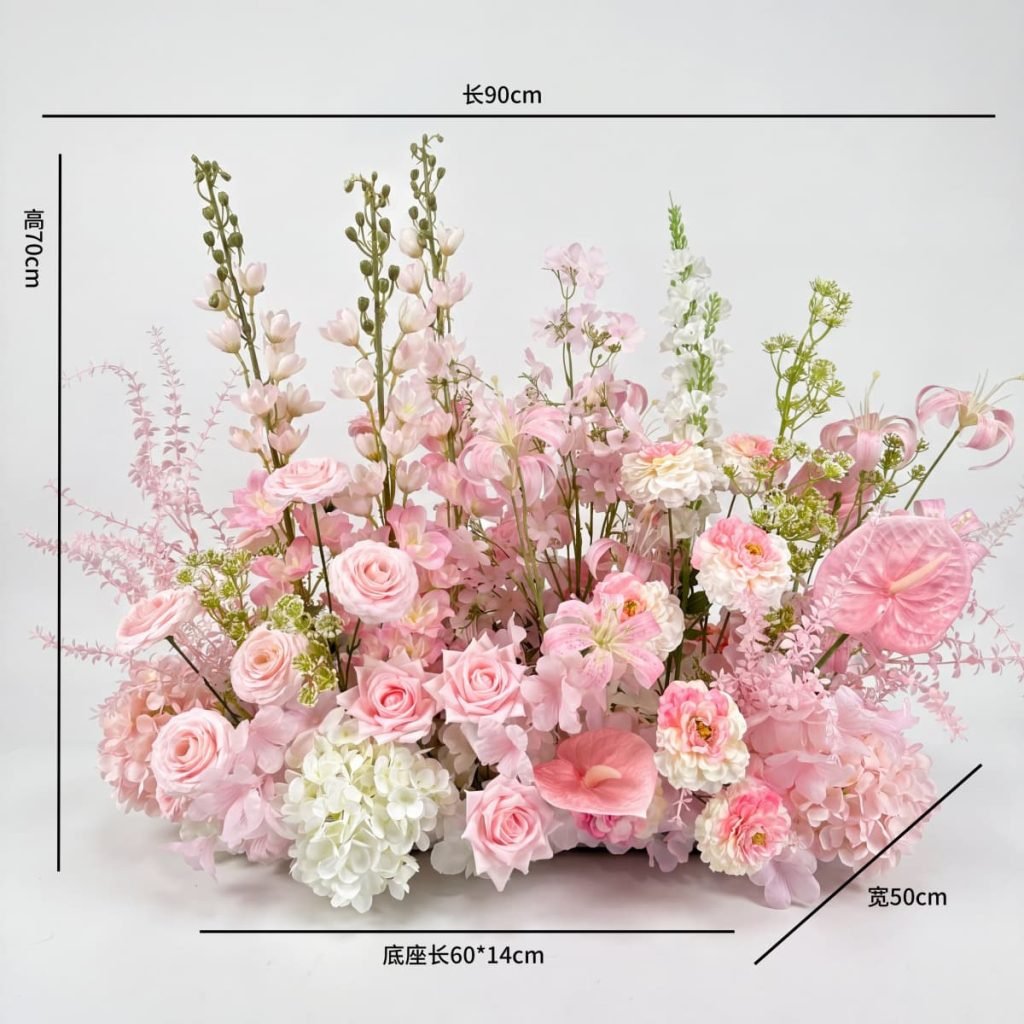
When buying aisle flowers in bulk, it is better to choose styles that are easy to tie, hang, remove, and reuse.
Common aisle flower sizes include 80 cm long × 40 cm wide × 60 cm high and 110 cm long × 40 cm wide × 40 cm high.
Hanging and Ceiling Flowers
Hanging flowers and ceiling flowers are often used for luxury weddings, hotel ballrooms, and commercial events. Common products include hanging wisteria, floral chandeliers, greenery vines, and ceiling floral decorations.
Artificial flowers are especially suitable for ceiling decoration because they are lightweight, do not need water, and can often be installed earlier than fresh flowers. This helps reduce pressure during event setup.
For this product category, buyers should pay attention to weight, length, local safety requirements, and installation method.
Fabric-back ceiling flower strings are hand-stitched, which helps prevent flowers from falling off. One square meter may use around 140 flower strings, and each string is about 1 meter long.
How to Choose High-Quality Artificial Wedding Flowers
Check the Material
Different materials are suitable for different wedding products.
Silk flowers are soft and natural-looking. They are often used for bouquets, table flowers, arches, and large wedding floral arrangements.
Foam flowers are lightweight and hold their shape well. They are suitable for large-area decoration, flower walls, and cost-effective wedding products.
Real touch flowers have a more realistic texture. They are often used for high-end bouquets, close-up arrangements, and luxury wedding details.
PE greenery and plastic leaves are more durable. They are commonly used for vines, garlands, greenery walls, and outdoor-style decoration.
Fabric flowers are cost-effective and suitable for large decorative use, especially when the product needs a full visual effect from a distance.
The right material depends on the application. A bridal bouquet may need more realistic flowers, while a large backdrop needs a balance between visual effect, weight, and cost.
Material affects the appearance, touch, weight, and cost of each product. If buyers are not sure which material to choose, they can start with this artificial flower material guide before comparing samples.
Check the Appearance
High-quality artificial wedding flowers should look natural both on-site and in photos. Buyers need to check whether the petals have a natural shape, whether the color looks too flat, and whether the flower heads are full enough.
Avoid products with obvious plastic shine, visible glue marks, poor color transitions, or thin-looking flower heads. For wedding decoration, overall fullness and color harmony are often more important than a single flower.
For bulk orders, quality should be checked from several details, including petal shape, color transition, flower fullness, stem structure, and overall durability. A simple quality checklist for artificial wedding flowers can help buyers avoid common problems before placing a large order.
Check Color Consistency
Color consistency is very important for bulk orders. A small color difference may not be obvious in one bouquet, but it can become very noticeable in 20 table centerpieces or a large flower wall.
Before placing a bulk order, ask the supplier whether the color can stay consistent between the sample and bulk production. For future restocking, also confirm whether the same color can be produced again.
If you need a special wedding color, ask whether the supplier supports custom color matching.
Check Structure and Durability
For event businesses, artificial flowers need to survive more than one use. They may go through packing, transport, installation, removal, storage, and reuse.
Check whether the flower heads are firmly attached, whether the stems can be bent without breaking, and whether the arrangement can recover its shape after packaging.
For flower walls, check the backing structure. For arches, check the connection points. For bouquets, check the handle and wrapping. For ceiling flowers, check whether the hanging parts are strong enough.
What Should You Confirm Before Placing a Bulk Order?
MOQ
MOQ means minimum order quantity. Different products may have different MOQ requirements.
Single artificial flowers, flower walls, arches, bouquets, and custom floral arrangements may all have different minimum order quantities. Custom colors, custom packaging, or private-label products usually require a higher MOQ.
Before asking for a quotation, it is better to prepare the product type, color, size, and estimated quantity. This helps the supplier give a more accurate price.
Samples
For B2B orders, samples are important. Samples help buyers confirm the material, color, size, flower density, packaging, and overall quality before bulk production.
When checking samples, do not only look at the product under indoor lighting. Take photos under natural light and check whether the color looks good on camera. Wedding flowers are often photographed, so the visual effect in photos matters.
Customization
Many wholesale artificial wedding flower suppliers can support customization. Common customization options include color, size, flower combination, product structure, label, logo, and packaging.
Some buyers also provide reference photos and ask suppliers to make a similar design. In this case, clear communication is important. It is better to provide the size, color theme, target budget, and application scenario.
Production Time
Production time depends on product type, order quantity, and customization requirements. Standard products are usually faster and often take about 7–15 working days. Custom flower walls, arches, and special-color floral arrangements depend on product complexity, but production time generally does not exceed 30 days.
Before the wedding season, buyers should plan earlier. Leaving enough time for sample confirmation, production, shipping, and customs clearance can reduce project risk.
Packaging
Packaging is one of the most important parts of wholesale artificial flower orders. Artificial flowers are usually lightweight but bulky. Poor packaging may cause crushed flowers, deformed arrangements, or higher shipping costs.
Before placing an order, confirm the carton size, gross weight, packing quantity, and product protection method.
For flower walls, confirm whether the wall is folded, rolled, or packed in separate sections. For bouquets, confirm whether they are individually packed. For arches and large floral arrangements, confirm whether the product is compressed and whether it can recover after unpacking.
A 2.4 × 2.4 m flower wall is often packed in sections. For example, it can be made with two 1.2 × 2.4 m panels. Each panel is packed in one carton, so one full flower wall needs two cartons.
Good packaging should protect the product and also make warehouse storage easier.
Shipping Cost
When buying artificial wedding flowers in bulk, the product unit price is only one part of the total cost. Because artificial flowers take up space, shipping costs may be calculated by dimensional weight instead of actual weight.
This is especially important for flower walls, arches, ceiling flowers, and large floral arrangements. The product may not be heavy, but the carton may be large.
For example, if one flower wall carton is 60 × 50 × 50 cm and the actual weight is about 12.2 kg, the logistics company may still charge based on a higher dimensional weight. In many international shipping cases, the chargeable weight may reach about 25–30 kg.
Before confirming an order, ask the supplier for carton size, gross weight, and CBM. This helps you estimate the real landed cost more accurately.
How to Calculate the Real Cost of Wholesale Artificial Wedding Flowers
When comparing suppliers, do not only look at the unit price. A lower product price does not always mean a lower final cost.
The real cost may include:
Product cost
Sample cost
Customization cost
Packaging cost
International shipping cost
Import duties
Local delivery cost
Warehouse storage cost
Maintenance and cleaning cost
A simple way to understand the total cost is:
Total Cost = Product Cost + Packaging Cost + Shipping Cost + Import Fees + Storage Cost + Maintenance Cost
For event rental companies, artificial wedding flowers should be treated as reusable inventory. If one flower wall, one arch set, or one group of table centerpieces can be used many times, the average cost per event will decrease as the number of uses increases.
For example, the first purchase cost of a flower wall may be higher than the fresh flower cost for one event. But if it is reused for multiple wedding projects, the average cost per event becomes lower. This is why many rental companies prefer durable, reusable, and easy-to-store floral products.
For rental companies, artificial flowers should be treated as reusable inventory rather than one-time decoration. Planning reusable wedding flower inventory can help reduce the average cost per event over time.
Fresh Flowers vs Artificial Wedding Flowers
| Factor | Fresh Flowers | Artificial Wedding Flowers |
|---|---|---|
| Use Time | Usually for one event only | Can be used for multiple events |
| Storage | Needs cold storage or freshness control | Dry storage is usually enough |
| Setup Time | More time-sensitive | Can be prepared in advance |
| Color Control | Affected by season and supply | More suitable for repeat themes |
| Waste | Higher waste after the event | Lower waste if stored properly |
| Packaging | Focuses on freshness | Must consider carton size and volume |
| Best For | Luxury fresh floral design | Rental inventory and repeat event decoration |
Artificial flowers cannot completely replace fresh flowers in every wedding. Some clients still prefer the fragrance and natural texture of fresh flowers. However, for event businesses that need reusable products, better cost control, and faster setup, artificial wedding flowers are a practical choice.
Some decorators also use a mixed approach. They use artificial flowers for large structures such as arches, flower walls, and ceiling installations, then add fresh flowers for close-up details.
What Products Are Suitable for Different Types of Buyers?
Wedding Planners
Wedding planners can focus on products that help create a complete wedding theme. Common products include bridal bouquets, bridesmaid bouquets, ceremony arch flowers, aisle flowers, and table centerpieces.
Classic wedding colors such as white, ivory, champagne, light pink, dusty rose, and burgundy are usually easier to match with different wedding themes.
Event Decorators
Event decorators usually need large visual products. Flower walls, wedding arches, ceiling flowers, stage backdrops, floral runners, and large entrance decorations are practical choices.
For decorators, product structure and installation method are very important. Products should be easy to assemble, remove, pack, and transport between different events.
Rental Companies
Rental companies should prioritize durable and reusable products. Suitable options include standard-size flower walls, modular arches, reusable table centerpieces, classic color floral sets, and easy-to-pack floral arrangements.
Rental companies also need to consider how much warehouse space each product requires. Large flower walls and arches may have good rental value, but they also need proper storage and transport planning.
Wholesalers and Retailers
Wholesalers and retailers may focus more on single stems, flower bunches, popular wedding colors, seasonal collections, and products that are suitable for standard carton packaging.
For these buyers, clear product categories, stable supply, and repeatable colors are especially important.
Common Mistakes When Buying Artificial Wedding Flowers in Bulk
One common mistake is only comparing product unit prices. In wholesale orders, shipping cost, packaging method, product durability, and reuse value are also important.
Another mistake is not checking samples. Product photos can show the general design, but they cannot fully show material, density, color, or packaging details.
Some buyers also ignore carton size and dimensional weight. For flower walls and large arches, this may lead to higher shipping costs than expected.
Another problem is ordering too many random colors at once. For rental companies, it is usually better to start with classic wedding colors such as white, ivory, champagne, blush pink, dusty rose, burgundy, and greenery. These colors are easier to reuse for different events.
Buyers should also confirm flower wall size, backing type, MOQ, production time, and color consistency before placing an order.
Many purchasing problems happen because buyers only compare product prices and ignore samples, packaging, carton size, and shipping weight. Learning the common mistakes when buying artificial wedding flowers in bulk can help avoid unnecessary extra costs.
How to Choose a Reliable Artificial Wedding Flower Supplier
A reliable supplier should provide more than a low price. For B2B buyers, a good supplier should help reduce problems related to quality, packaging, shipping, and restocking.
When choosing a supplier, check the following points:
Does the supplier offer a complete wedding floral product line?
Can they provide samples before bulk production?
Do they support color, size, and packaging customization?
Do they understand export packaging requirements?
Can they provide carton size, weight, and CBM?
Do they inspect the products before shipment?
Is communication clear and timely?
Can they support future repeat orders?
For event businesses, supplier stability is very important. If your rental catalog is built around certain colors and styles, you need a supplier that can support future restocking and color consistency.
A low price does not always mean a good wholesale order. Working with a reliable artificial flower supplier can help you better control product quality, packaging, lead time, and repeat-order consistency.
Conclusion
Wholesale artificial wedding flowers are not only decorative products. For event businesses, they can become reusable inventory that supports repeated projects, faster setup, and more stable cost planning.
Before placing a bulk order, buyers should compare material, appearance, color consistency, MOQ, samples, packaging, shipping cost, and supplier reliability.
Real product data, such as flower wall backing type, carton size, actual weight, dimensional weight, and arch packaging size, can help buyers make more accurate purchasing decisions.
Choosing the right artificial wedding flower supplier can help wedding planners, event decorators, rental companies, and wholesalers build a more practical and profitable floral product inventory.
Looking for wholesale artificial wedding flowers for your event business? Contact us to explore wedding flower walls, arches, bouquets, table centerpieces, ceiling flowers, and custom floral solutions for bulk orders.
FAQ
1.Are artificial wedding flowers suitable for professional event decoration?
Yes. High-quality artificial wedding flowers can be used by wedding planners, event decorators, rental companies, hotels, banquet halls, and commercial event spaces.
2.Can artificial wedding flowers be reused?
Yes. Many artificial wedding flowers can be used for multiple events if they are packed, transported, cleaned, and stored properly.
3.What artificial flowers are suitable for wedding arches?
Silk flowers, foam flowers, and mixed greenery are commonly used for wedding arches because they are lightweight, full-looking, and easy to install.
4.What should I check before buying artificial flower walls in bulk?
You should check the backing type, size, flower density, panel structure, packaging method, carton size, and installation method.
5.What is the difference between grid flower walls and fabric-back flower walls?
Grid flower walls usually use plastic backing panels and are often quoted by single panel size, such as 60 × 40 cm. Fabric-back flower walls are usually quoted by square meter and can often be rolled up for easier storage and transport.
6.Can artificial wedding flowers be customized?
Yes. Common customization options include color, size, flower combination, product structure, label, logo, and packaging.
7.How can I reduce shipping costs when buying artificial wedding flowers in bulk?
Confirm the carton size, gross weight, CBM, and packaging method before placing an order. For bulky products such as flower walls and arches, packaging design can affect the final shipping cost.