

Reference photos can show the style and colors, but they are not enough to prepare a reception flower order. Table count, venue layout, dimensions, and installation conditions all affect the final quantity and product specifications.
A practical planning process should follow this order:
Floor Plan → Venue Constraints → Areas → Quantities → Specifications → Order Structure → Packing and Setup → Final Order Sheet
This wedding reception flower checklist helps event decorators turn a layout into a clear artificial flower order for supplier quotation and production.
Start With the Floor Plan and Venue Constraints
Divide the Reception Into Flower Zones
Before choosing products, divide the reception into clear flower zones. These may include guest tables, the sweetheart or head table, stage, backdrop, entrance, welcome area, seating chart, cake table, bar, lounge, ceiling, and staircase.
Give each area a simple Zone ID, such as GT for guest tables, ST for the sweetheart table, and BG for the backdrop. This makes quantities, specifications, packing, and approval status easier to track.
Then classify each zone as:
- Primary: main visual areas and repeated table flowers
- Secondary: supporting areas such as welcome signs or cake tables
- Optional: areas that are not yet confirmed
Ceremony and reception spaces should be planned separately because their layouts, quantities, and installation requirements are different. Decorators working on both areas can also use our guide to planning artificial wedding flowers for ceremony areas.
Record the Layout Details That Change the Order
The floor plan should show more than the guest count. Record the number of tables, table shape, table dimensions, stage size, backdrop size, and ceiling height.
Also check existing structures and access routes. These details can affect product size, quantity, packing, and installation.
| Project Detail | What to Confirm | Why It Matters |
|---|---|---|
| Guest tables | Number, shape, dimensions | Affects repeated flower quantities |
| Stage | Width and height | Affects arrangement scale |
| Backdrop | Overall dimensions | Affects coverage and product size |
| Ceiling | Height | Affects hanging installations |
| Existing structures | Frames, stands, rigging points | Affects what must be ordered |
| Access routes | Doors, lifts, corridors | Affects product size and packing |
Confirm Venue Restrictions Before Selecting Products
Check venue rules before finalizing the flower list. Some locations do not allow wall attachment, ceiling suspension, or certain adhesives.
Also confirm whether frames, ladders, lifts, or other access equipment are available. Load-in time, door width, and storage space during setup may also affect the order.
For example, one UIMI telescopic flower wall frame for a 2.4 × 2.4 m setup can adjust from 1.5 × 1.5 m to 2.4 × 2.4 m. The poles pack at about 165 × 20 × 10 cm and weigh around 5.8 kg, while the base is about 45 × 45 × 2 cm and weighs around 16 kg. The poles and base are packed separately.
This is why access routes and handling conditions should be checked before the frame is added to the order.
| Venue Detail | What to Check | Possible Order Impact |
|---|---|---|
| Wall attachment | Allowed or restricted | Changes fixing method |
| Ceiling suspension | Allowed and rigging available | Affects hanging flower options |
| Existing frames | Size and condition | May reduce extra hardware |
| Adhesive rules | Allowed materials | Changes installation accessories |
| Access equipment | Ladders or lifts available | Affects installation planning |
| Load-in time | Available setup window | Affects product format |
| Door and access size | Width and height limits | Affects packing and assembly |
| Storage area | Space available during setup | Affects carton handling |
Build the Reception Flower Checklist by Area
Guest Table Flowers
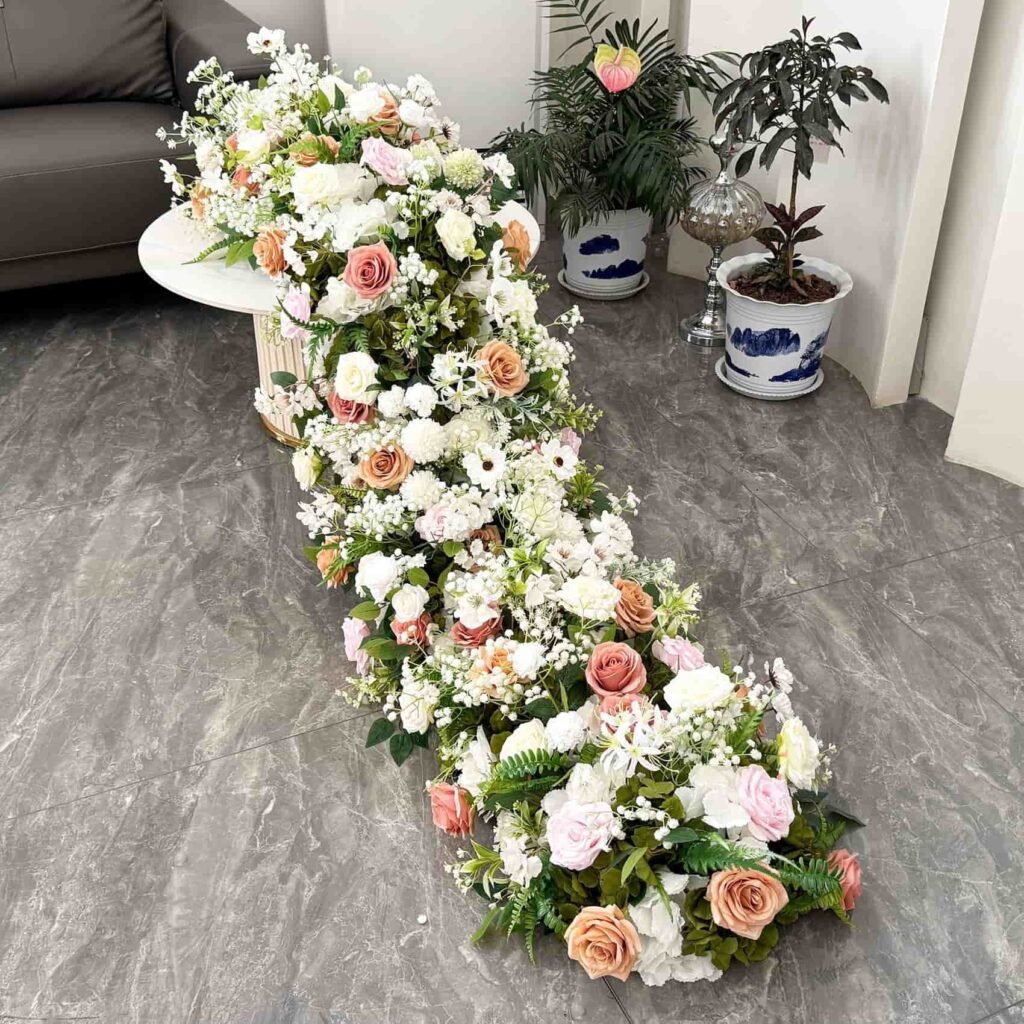
Start with the number of decorated tables, not the total guest count. Round and long tables often need different flower layouts.
Confirm:
- Number of tables
- Centerpieces or floral runners
- Units per table
- Arrangement width and height
- Guest sightlines
- Space needed for plates, glasses, and candles
- Whether the base or vase is included
For example, two receptions with the same guest count may need very different quantities if one uses ten large round tables and the other uses twenty smaller tables.
Actual product dimensions also show why table size matters. In UIMI’s current range, one flower runner measures 100 × 35 cm and weighs about 1.5 kg, while another measures 200 × 35 cm and weighs about 2.9 kg.
The buyer should match the runner length to the actual table and decide whether one long piece or several shorter units are needed.
Sweetheart Table and Head Table Flowers
Record the table width, number of seated people, and visible front length.
Then decide:
- Full or partial flower coverage
- Tabletop or front-mounted arrangement
- Whether the backdrop is a separate order item
- How the table flowers should relate to the backdrop
A reference image often shows only the front view. The actual table dimensions are still needed before the arrangement can be sized correctly.
Stage and Reception Backdrop Flowers
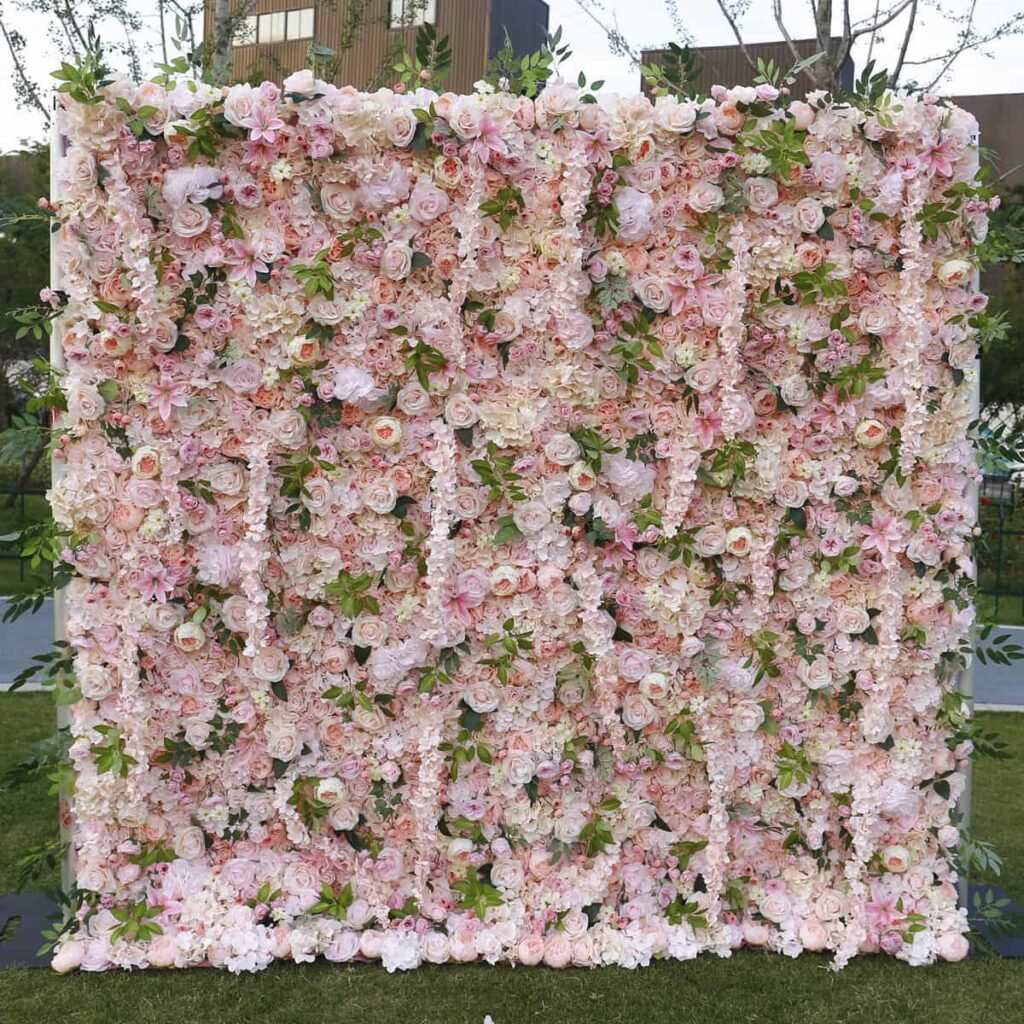
First confirm whether the stage and backdrop are one installation or two separate order items.
Check:
- Existing frame
- Overall width and height
- Full or partial coverage
- Number of visible sides
- Freestanding or frame-mounted installation
Panel format also affects packing and setup. For example, one 2.4 × 2.4 m fabric-back flower wall in UIMI’s current range is made as two 1.2 × 2.4 m sections. Each section is packed in a 60 × 50 × 50 cm carton and weighs about 12.2 kg.
This is why the buyer should confirm the panel format, access route, and support frame before finalizing the backdrop order.
Buyers using a full flower wall should also check the panel size, backing system, and wholesale buying details before confirming the backdrop order.
Entrance and Welcome Areas
Confirm the number of entrances and the size of any welcome signs.
Also check:
- Single or paired arrangements
- Stand height
- Floor footprint
- Guest traffic around the display
Large arrangements should not block walkways, check-in areas, or the main guest route.
Cake Table, Bar, and Other Secondary Areas
Secondary areas may include the cake table, bar, gift table, seating chart, and lounge area.
Before adding a separate arrangement, ask:
- Is this area visible in key photos?
- Does it already have other décor?
- Does it need its own flower arrangement?
- Is it confirmed or still optional?
Not every area needs to become a separate purchase item. Keeping optional zones separate makes the quotation easier to control.
Hanging Flowers and Ceiling Installations
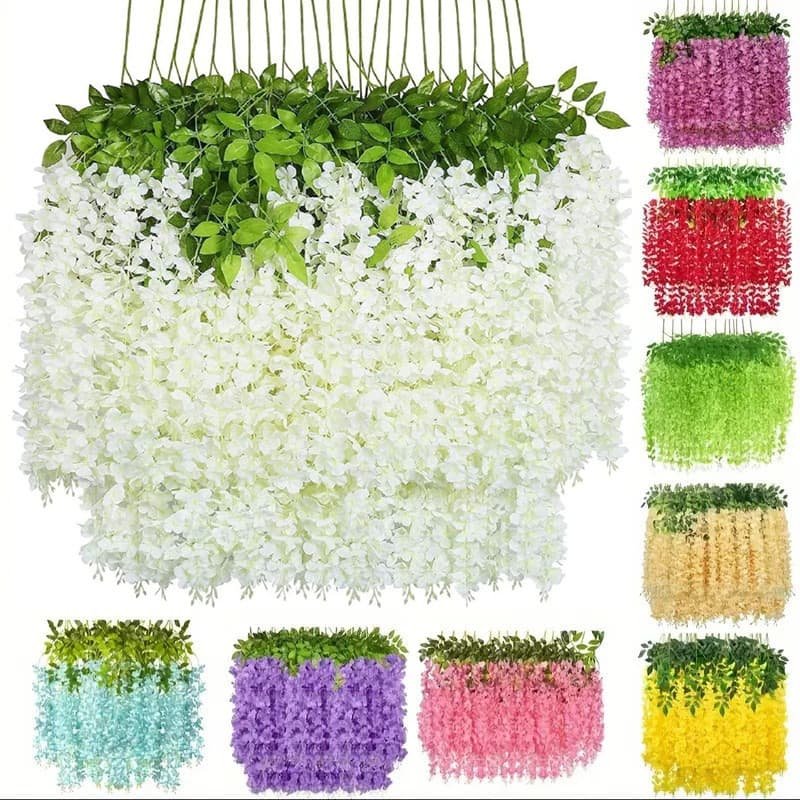
Confirm venue approval before adding hanging flowers to the order.
Check:
- Ceiling height
- Rigging points
- Existing support
- Module size
- Number of modules
- Access equipment
- Available setup time
Ceiling coverage should also be linked to the actual product format. For one fabric-base ceiling flower design in UIMI’s current range, the density is about 140 strands per square meter, with each strand around 1 m long.
A 2.4 × 2.4 m set is packed in two 50 × 40 × 40 cm cartons, with each carton weighing about 7.5 kg. The buyer should confirm the ceiling area, rigging points, and setup time before deciding the final quantity.
| Reception Area | Common Product Type | Main Quantity Driver | Required Specifications |
|---|---|---|---|
| Guest tables | Centerpieces or floral runners | Number and type of tables | Size, height, base, units per table |
| Sweetheart table | Floral runner or front arrangement | Table width | Coverage length and fixing method |
| Stage | Standing arrangements | Stage size | Height, width, visible sides |
| Backdrop | Flower wall or floral structure | Backdrop dimensions | Coverage, frame, installation method |
| Entrance | Floral stands | Number of entrances | Stand height and floor footprint |
| Welcome area | Sign flowers | Number and size of signs | Arrangement size and attachment method |
| Secondary areas | Small arrangements | Number of confirmed areas | Size and placement |
| Ceiling | Hanging modules | Ceiling area and rigging points | Module size, quantity, installation method |
Calculate Flower Quantities From the Layout
Calculate Repeated Units
Repeated items should be counted from the actual number of locations.
This may include:
- Guest table centerpieces
- Floral runners
- Cocktail table flowers
- Welcome sign flowers
- Paired entrance arrangements
Use a simple formula:
Number of locations × Units per location = Total units
For example, 20 guest tables with one centerpiece per table require 20 units. Do not estimate from guest count alone.
Count Focal Installations Separately
Main focal areas should be calculated one by one.
These may include:
- Sweetheart table
- Stage
- Backdrop
- Main entrance
- Ceiling installation
For each area, confirm:
- Dimensions
- Quantity
- Coverage
- Structure
A stage and backdrop may look like one visual area, but they may still need two separate order items.
Separate Confirmed, Pending, and Optional Areas
Do not add unconfirmed areas to the final purchase quantity. Rental companies should also compare the project quantity sheet with their existing artificial wedding flower inventory before adding new units to the order.
Use three simple statuses:
- Confirmed: ready to order
- Pending: waiting for client approval
- Optional: possible add-on
This makes the quotation easier to update when the project changes.
| Area | Number of Locations | Units per Location | Total Units | Status |
|---|---|---|---|---|
| Guest tables | 20 | 1 | 20 | Confirmed |
| Welcome signs | 2 | 1 | 2 | Confirmed |
| Main entrance | 1 | 2 | 2 | Pending |
| Sweetheart table | 1 | 1 set | 1 set | Confirmed |
| Ceiling installation | — | — | — | Optional |
Turn Reference Images Into Orderable Specifications
Define Size and Visible Coverage
A reference image shows the look, but not the actual size.
Confirm:
- Width
- Height
- Depth
- Full or partial coverage
- One-sided or multi-angle visibility
The same design may need very different dimensions for a guest table, stage, or backdrop.
Describe the Shape, Flower Mix, and Density
Define the overall shape before ordering.
Common options include:
- Low and wide
- Tall
- Asymmetrical
- Compact
Also confirm:
- Main flower types
- Filler flowers
- Greenery ratio
- Overall density
This gives the supplier a clearer product brief than a reference image alone.
Define the Color Direction
Do not rely on a color name alone.
Confirm:
- Dominant color
- Secondary color
- Accent color
- Reference image
- Approved color sample
- Venue background
- Lighting conditions
For example, “champagne” may refer to different shades, so a visual reference is more useful than the color name alone.
Confirm the Structure and Installation Method
The installation method should be confirmed before production.
Common options include:
- Freestanding
- Frame-mounted
- Clipped
- Tied
- Hung
- Base-mounted
Also check:
- Is the stand included?
- Is the base included?
- Is the hardware included?
- Is the main structure supplied by the venue?
| Reference Image Detail | Order Specification Needed |
|---|---|
| Overall look | Width, height, and depth |
| Flower coverage | Full or partial coverage |
| Viewing angle | One-sided or multi-angle |
| Shape | Low, tall, asymmetrical, or compact |
| Flower mix | Main flowers, fillers, and greenery ratio |
| Color | Main, secondary, and accent shades |
| Installation | Freestanding, mounted, clipped, tied, or hung |
| Structure | Stand, base, hardware, or venue-supplied frame |
For a broader view of the product types used across wedding projects, buyers can also review our artificial flowers for wedding range.
Decide What Should Be Standard and What Needs Custom Sizing
Keep Repeated Pieces Consistent
Repeated items are easier to order when the specifications stay consistent.
This may include:
- Guest table centerpieces
- Floral runners
- Cocktail table arrangements
- Repeated entrance pieces
Keep the following details the same where possible:
- Dimensions
- Base
- Color palette
- Fixing method
This also makes the quantity sheet and supplier quotation easier to check.
Use Project-Specific Sizing for Focal Areas
Main focal areas often need dimensions based on the actual venue.
This may include:
- Sweetheart table
- Stage
- Main backdrop
- Ceiling installation
Confirm the real table, stage, or structure size before ordering. A reference image alone cannot show the required scale.
Ask for a Clear Quotation Breakdown
Ask the supplier to separate the quotation into:
- Standard items
- Color-adjusted items
- Custom items
- Frames and stands
- Installation accessories
- Spare components
This makes it easier to check costs and update the order if the project changes. Projects that combine standard, color-adjusted, and custom items may need a more detailed bulk artificial flower ordering plan.
Plan Hardware, Packing, and On-Site Setup
Make a Separate Hardware Checklist
Do not mix installation hardware with the flower quantity list.
Check:
- Stands
- Bases
- Clips
- Ties
- Connectors
- Replacement parts
Confirm which items are included and which must be ordered separately.
Pack and Label Products by Reception Zone
Use the same Zone IDs from the project plan.
For example:
- GT — Guest Tables
- ST — Sweetheart Table
- EN — Entrance
- BG — Backdrop
Each carton label can include:
- Zone
- Product
- Quantity
- Carton number
This makes products easier to distribute during setup.
Plan the Setup Sequence
The installation order should follow the actual venue conditions.
Consider:
- Venue access
- Other vendors
- Installation height
- Table setup schedule
Large or high installations may need to be completed before other areas. Guest tables and smaller zones may be handled later.
Do not use one fixed setup order for every project.
| Check Item | What to Confirm |
|---|---|
| Hardware | Stands, bases, clips, ties, and connectors |
| Replacement parts | Extra components needed on-site |
| Zone label | Reception area or Zone ID |
| Carton label | Product, quantity, and carton number |
| Venue access | When and where products can enter |
| Installation height | Whether ladders or lifts are needed |
| Other vendors | Whether setup areas will overlap |
| Table schedule | When guest tables are ready for flowers |
Build the Final Reception Flower Order Sheet
Project Information
Start with the basic project details:
- Event date
- Venue
- Setup date and time
- Floor plan version
Use the latest floor plan version to avoid ordering from outdated information.
Area and Quantity Information
Record each reception zone separately.
Include:
- Zone ID
- Reception area
- Number of locations
- Units per location
- Total quantity
This makes repeated items and focal installations easier to check.
Product Specifications
For each item, record:
- Product or reference image
- SKU
- Dimensions
- Color
- Shape
- Coverage
Do not rely on the product name or reference image alone.
Installation and Packing Information
Add the details needed for delivery and setup:
- Installation method
- Existing structure
- Stand
- Base
- Accessories
- Packing label
This helps prevent missing hardware and mixed cartons.
Order and Approval Status
Mark each item as:
- Standard
- Color-adjusted
- Custom
Then add the approval status:
- Confirmed
- Pending approval
Only confirmed items should be included in the final purchase quantity.
| Zone ID | Reception Area | Locations | Units per Location | Total Qty | Product / SKU | Specifications | Installation | Packing Label | Order Type | Status |
|---|---|---|---|---|---|---|---|---|---|---|
| GT | Guest tables | 20 | 1 | 20 | Centerpiece / SKU | Size, color, shape | Tabletop | GT | Standard | Confirmed |
| ST | Sweetheart table | 1 | 1 set | 1 set | Reference image | Size, coverage, color | Front-mounted | ST | Custom | Confirmed |
| BG | Backdrop | 1 | 1 set | 1 set | Reference image | Dimensions, coverage | Frame-mounted | BG | Custom | Pending approval |
Conclusion
A useful reception flower checklist should connect the floor plan, area quantities, product specifications, installation requirements, and supplier quotation. This gives both the buyer and supplier a clear record of what is needed for each reception zone.
Buyers managing a wider range of wedding products can also review our wholesale artificial wedding flowers guide for more information on product planning and sourcing.
For a quotation, send UIMI your floor plan, table count, reference images, and confirmed dimensions. We can then help prepare a clearer product list and more accurate quotation for your reception project.
FAQ
What should be included in a wedding reception flower checklist?
A practical checklist should include the reception areas, quantities, dimensions, colors, installation methods, hardware, packing labels, and approval status.
How do you calculate the number of flower arrangements for a reception?
Start with the actual number of locations. For repeated items, use:
Number of locations × Units per location = Total units
Focal areas such as the stage, backdrop, and sweetheart table should be calculated separately.
What information should I send before requesting a quotation?
Send the latest floor plan, table count, venue details, reference images, confirmed dimensions, color direction, and installation requirements.
Are reference images enough to order artificial wedding flowers?
No. Reference images show the style, but the supplier still needs dimensions, coverage, flower density, colors, structure, and installation details.
Should standard and custom reception flowers be listed separately?
Yes. Separate standard items, color-adjusted items, custom pieces, frames, stands, and installation accessories. This makes the quotation easier to check and update.