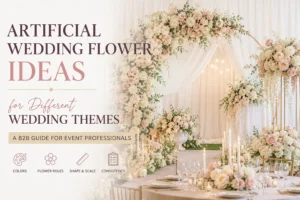

For many event businesses, the first artificial wedding flower order starts with a product photo.
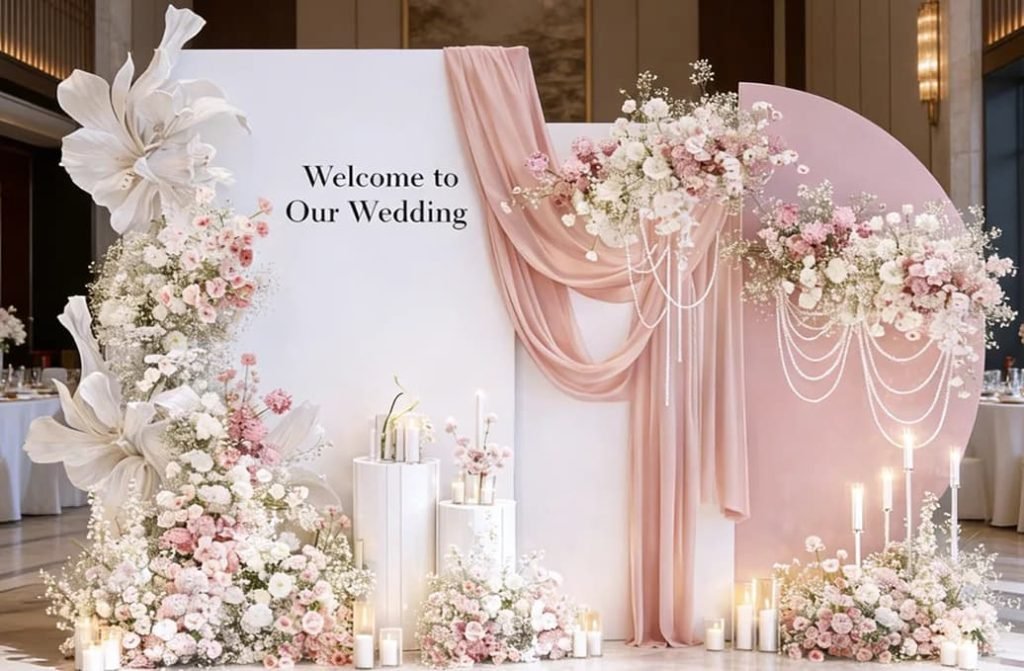
A buyer may send us a picture of a flower wall, an arch setup, or a table arrangement and ask, “Can you make this?” But before we talk about price, there are usually a few more important questions to confirm: where the flowers will be used, how many events they need to support, how they will be stored, and whether the same color may need to be reordered later.
This is why a buying checklist is useful. It helps wedding planners, event decorators, and rental companies avoid ordering flowers that look good in photos but do not work well in real event use.
If you are still learning about product types, supplier options, and wholesale purchasing basics, you can also read our complete guide to wholesale artificial wedding flowers.
Why Event Businesses Need a Buying Checklist
Buying artificial wedding flowers for business use is different from buying flowers for one personal wedding.
Event businesses need to consider more practical questions, such as:
- Will the flowers be reused for multiple events?
- Can they survive transport, setup, and storage?
- Do they match different wedding themes?
- How much inventory is enough?
- Will the same style be available for repeat orders?
- Can the flowers be packed, labeled, and stored easily?
- Will the total landed cost still leave enough profit?
Without a clear checklist, it is easy to make emotional buying decisions based on beautiful photos or low prices. But after the order arrives, you may find that the flowers are difficult to store, too fragile for rental use, expensive to ship, or hard to reorder later.
A good buying checklist helps you choose artificial wedding flowers based on real business needs, not just appearance.
1. Are the Flowers for One Event or Rental Inventory?
The first question is simple but very important:
Will these flowers be used for one event, or will they become part of your reusable inventory?
These two situations require different buying standards.
If the flowers are for one wedding or one project, appearance may be the top priority. You may accept a more delicate structure if the flowers only need to look beautiful for one event.
But if the flowers are for rental inventory, durability becomes much more important. They need to survive repeated packing, transport, installation, removal, cleaning, and storage.
For rental inventory, you should consider:
- Stronger stems
- Secure flower heads
- Flexible but durable branches
- Easy-to-clean surfaces
- Stable colors
- Designs that are easy to repair
- Products that can be reused across different themes
For one-time event use, you may focus more on:
- Visual effect
- Color matching
- Photo performance
- Budget control
- Fast delivery
- Theme-specific designs
This difference matters because buying the wrong type can reduce your profit. If you buy fragile flowers for rental use, they may look good at first but break after only a few events. If you buy overly durable and expensive flowers for a one-time project, you may spend more than necessary.
Before ordering, decide clearly whether this purchase is for a single project or long-term event inventory.
2. Where Will the Flowers Be Used in the Event Setup?
Artificial wedding flowers are used in many different areas of an event. Each placement has different requirements.
A flower used in a bridal bouquet does not need the same structure as a flower used in a hanging ceiling installation. A flower wall does not need the same stem length as an aisle arrangement.
Before buying, list where the flowers will be used.
Common event applications include:
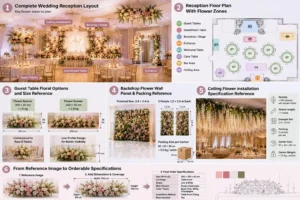
- Flower walls and photo backdrops
- Wedding arches and ceremony flowers
- Table centerpieces
- Aisle flowers
- Chair or pew decorations
- Hanging ceiling florals
- Bridal bouquets
- Bridesmaid bouquets
- Corsages and wrist flowers
- Entrance decoration
- Stage or banquet hall decoration
Each application has different priorities.
| Event Area | Main Buying Focus | Details to Check |
|---|---|---|
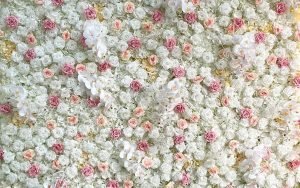
| Flower walls | Full visual coverage, easy installation, suitable weight | Backing, panel size, flower density |
| Wedding arches | Shape, balance, coverage, frame compatibility | Whether flowers include frame or only floral pieces |
| Table centerpieces | Stable structure, proper height, no strong smell | Should not block guest views |
| Aisle flowers | Easy fixing, durable stems, outdoor stability | Need ties, clips, or bases |
| Hanging florals | Lightweight structure, flexible stems | Safety and installation method are important |
| Bridal bouquets | Hand feel, secure binding, close-up realism | No exposed wire or sharp edges |
This step helps you avoid buying flowers that look attractive but do not match the actual setup needs.
For example, large flower heads may look beautiful in photos, but they may be too heavy for ceiling decoration. Long stems may be useful for arrangements, but unnecessary for flower walls. Very delicate petals may be suitable for bridal bouquets, but not ideal for rental aisle flowers that are handled repeatedly.
A smart event buyer chooses flowers based on placement, not only appearance.
3. How Accurate Does the Wedding Color Need to Be?
Color is one of the most important details in wedding decoration.
For some events, a general color direction is enough. For example, “cream white,” “dusty pink,” or “champagne” may be acceptable if the overall style looks coordinated.
For other events, especially high-end weddings, branded events, or custom themes, the color requirement may be much stricter.
Before ordering, ask yourself:
- Do I need an exact Pantone color match?
- Is a similar color acceptable?
- Will these flowers be used under warm light, natural light, or stage lighting?
- Do I need all products in the same color family?
- Will I reorder the same color later?
- Can I accept slight batch differences?
Artificial flowers may look different under different lighting conditions. A blush pink flower may appear warmer under indoor lighting. A champagne flower may look more yellow in photos. A dusty rose tone may look different on different materials.
For event businesses, it is better to test colors before placing a large order.
You can ask your supplier for:
- Real product photos
- Natural light photos
- Short videos
- Color samples
- Material swatches
- Sample stems
- Custom color confirmation
If your event requires strict color matching, provide a clear reference, such as a Pantone number, fabric swatch, or physical sample. Do not rely only on screenshots or edited photos.
Color planning is especially important when ordering matching flower walls, wedding arches, bouquets, table flowers, and hanging florals together. If the colors come from different batches or product lines, the final event setup may look inconsistent.
4. How Much Inventory Do You Really Need?
From our experience, small weddings usually focus on a few high-impact areas, such as the ceremony arch, bridal bouquet, and table flowers. Medium weddings often need a complete matching set, including flower walls, arches, centerpieces, aisle flowers, and bridal party flowers. Large weddings require a more detailed inventory plan, because the buyer must consider table quantity, entrance decoration, stage design, hanging florals, shipping volume, and extra replacement flowers.
| Wedding Size | Guest Count | Main Buying Focus | Recommended Products |
|---|---|---|---|
| Small Wedding | 20–50 guests | Focus on key visual areas | Wedding arch flowers, a small number of table centerpieces, bridal bouquet, 4–6 aisle flower sets, small backdrop flowers |
| Medium Wedding | 60–150 guests | Build a complete matching wedding set | Flower wall, wedding arch, 10–20 table centerpieces, 8–12 aisle flower sets, head table flowers, bridesmaid bouquets |
| Large Wedding | 150–300+ guests | Plan full venue decoration and backup inventory | Large wedding arch, flower wall, 25–50+ table centerpieces, hanging florals, entrance flowers, stage flowers, 10% extra replacement flowers |
5. Can Your Warehouse Store These Flowers Properly?
Storage is often ignored before purchasing artificial wedding flowers.
But storage conditions can affect product shape, cleanliness, color, and service life. If your warehouse is not suitable, even good-quality flowers may become dusty, flattened, or difficult to reuse.
Before ordering, check your storage situation.
Important questions include:
- Is the storage area dry?
- Is the space clean and dust-controlled?
- Are shelves strong enough?
- Can large flower walls or arches be stored without being crushed?
- Can different colors and styles be separated clearly?
- Do you have boxes, racks, or garment-style storage bags?
- Can your team easily find and repack products after each event?
Humidity is also important. Fabric flowers may not perform well in damp storage. Dust can collect quickly on textured petals and leaves. Heavy boxes can crush delicate flower heads if they are stacked incorrectly.
For rental companies, storage should be part of the buying decision.
If your space is limited, avoid buying too many large pre-assembled products at once. If your warehouse is spacious and dry, you can consider larger flower walls, arches, or complete wedding sets.
Good storage planning helps extend the life of your artificial flower inventory.
6. Have You Planned for Repair and Replacement Costs?
Artificial flowers are reusable, but they are not indestructible.
For event rental companies, some damage is normal. Flowers may be bent during transport, petals may loosen after repeated use, and small accessories may go missing after events.
Before buying, plan for repair and replacement.
You should consider:
- Which products will be handled most often?
- Which flowers are most likely to be damaged?
- Can your team repair loose flower heads?
- Do you need extra stems or spare petals?
- Should you buy extra pieces for high-use products?
- How much replacement cost should be included in your pricing?
For example, bridal bouquets, chair flowers, aisle decorations, and table pieces may be touched and moved often. These items may need more frequent repairs than a flower wall used mainly as a backdrop.
A practical method is to order extra quantities for fragile or high-use styles. For popular flowers, buying 5–10% extra can help you replace damaged pieces without disrupting future events.
This is especially useful for rental inventory. If a few flowers are damaged, you can repair the set instead of retiring the whole design.
Repair planning may not sound exciting, but it directly affects profit.
For a more detailed look at flower head structure, stem strength, and realistic appearance, read our guide on how to choose high-quality artificial wedding flowers.
7. Can Your Timeline Handle Production, Shipping, and Peak Season Delays?
Event businesses work with strict deadlines. If flowers arrive late, the whole project may be affected.
Before placing an order, do not only ask about standard production time. You should plan the full timeline from sample confirmation to final delivery.
A complete timeline may include:
- Product selection
- Sample order
- Sample delivery
- Color confirmation
- Bulk production
- Quality checking
- Packing
- International shipping
- Customs clearance
- Local delivery
- Warehouse checking
- Event preparation
If you place your order during peak wedding season, production and shipping times may be longer than usual.
From our production perspective, April to June and September to November are the peak shipping periods for wedding floral arrangements each year. The same design might take 15 days to deliver during the off-season, but often 25-30 days during peak season. If a customer adds to their order or changes colors, the lead time will be further extended.
We’ve also had customers contact us at the end of June, saying they need the floral arrangements for their mid-July wedding and asking if we could expedite the process. In such cases, we can only help them choose from our existing inventory; custom colors and sizes simply don’t have the time.
Therefore, when we receive new clients, the first thing we ask is: When do you expect to need the floral arrangements? Have you allowed for sample confirmation and a shipping buffer in the backwards timeline? If the timeframe is too tight, we will directly explain which arrangements are feasible and which are not recommended.
A good buying plan should leave enough buffer.
8. Do You Understand the Real Landed Cost?
The product price is only one part of the total cost.
Artificial wedding flowers are often lightweight but bulky. This means shipping volume can have a major impact on the final cost.
Before buying, calculate the real landed cost, not just the unit price.
The landed cost may include:
- Product cost
- Packaging cost
- International shipping
- Customs duty
- Import tax
- Port charges
- Local delivery
- Warehouse handling
- Repair or replacement cost
- Storage cost
For large products such as flower walls, wedding arches, hanging florals, and full decoration sets, shipping volume can be significant. A product with a lower unit price may become expensive after adding freight.
For example, one artificial wedding flower arch set with a size of about 1.9m + 2.3m can be packed in one carton. The carton size is around 60 × 40 × 60 cm, and the actual weight is about 5.6 kg.
At first, 5.6 kg may not sound heavy. But for international express or air freight, shipping is often calculated by volumetric weight, not only actual weight. With a carton size of 60 × 40 × 60 cm, the volumetric weight may be around 24–28.8 kg, depending on the carrier’s calculation method.
This means the shipping cost may be based on a much higher weight than the real product weight. For bulky artificial wedding flowers, carton size can affect the final cost more than many buyers expect.
That is why we always suggest confirming carton size, gross weight, CBM, and shipping method before placing a wholesale order. A low product price does not always mean a low landed cost.
9. Have You Tested Samples Before Ordering Larger Quantities?
Samples are important because catalog photos cannot show everything.
A flower may look beautiful in a picture, but you still need to know how it performs in real use. For event businesses, sample testing should be more practical than simply checking appearance.
When you receive samples, test them in conditions similar to your real event work.
You can check:
- Does the color look right under your event lighting?
- Are the stems strong enough?
- Are the flower heads secure?
- Can the flowers be inserted into foam or attached to structures?
- Do they lose petals easily?
- Can they be packed and unpacked without damage?
- Are they easy to clean?
- Is there any strong smell?
- Do they match your existing inventory?
For rental companies, it is useful to test a small sample pack instead of only one stem. A mixed sample pack gives a better idea of how different flowers work together in a real arrangement.
Final Artificial Wedding Flower Buying Checklist
Before ordering artificial wedding flowers for your event business, use this checklist to review your needs.
| Buying Area | Questions to Ask |
|---|---|
| Business Use | Are the flowers for one event or reusable rental inventory? |
| Event Placement | Will they be used for flower walls, arches, tables, aisles, bouquets, or hanging decoration? |
| Color Needs | Do you need exact color matching, Pantone colors, or general theme colors? |
| Inventory Quantity | How many events should your inventory support before reordering? |
| Storage | Can your warehouse keep the flowers dry, clean, and uncrushed? |
| Repair Plan | Do you need extra flowers for repair, replacement, or high-use products? |
| Timeline | Is there enough time for samples, production, shipping, and preparation? |
| Landed Cost | Have you calculated shipping volume, customs, taxes, and local delivery? |
| Sample Testing | Have you tested samples under real event conditions? |
| Reorder Plan | Can the same style and color be reordered later? |
| Supplier Support | Can your supplier provide photos, videos, catalogs, and order recommendations? |
How to Use This Checklist Before Contacting a Supplier
Before sending an inquiry, prepare your answers to the most important checklist points.
A strong inquiry should include:
- Your business type
- Product application
- Reference photos
- Preferred colors
- Quantity range
- Delivery country
- Expected delivery date
- Whether samples are needed
- Whether the order is for rental, resale, or one project
- Any packaging or shipping preferences
For example, instead of writing:
How much are your wedding flowers?
You can write:
We are an event rental company looking for artificial wedding flowers for reusable inventory. We need flowers for arches, table centerpieces, and flower walls in cream white and champagne tones. Our first order may support 3–4 weddings, and we need delivery to the United States before May. Could you recommend suitable products and provide a quotation with estimated shipping volume?
This type of inquiry helps the supplier respond with more useful recommendations and a more accurate quotation.
Clear communication saves time and reduces order risk.
Conclusion
Choosing artificial wedding flowers for an event business is not only about finding beautiful products. It is about building an inventory that supports your projects, protects your profit, and helps your team work more efficiently.
Before placing your next wholesale order, take time to review your business use, event placement, color needs, storage conditions, repair plan, timeline, shipping cost, and sample testing process.
A clear buying checklist can help you avoid unsuitable products, reduce hidden costs, and build a more reliable artificial wedding flower inventory for future events.
Looking for artificial wedding flowers for your event business? Explore our artificial wedding flower collection or contact UIMI to get the latest catalog, color options, and product recommendations based on your wedding decoration needs.