
A wedding backdrop is more than a decorative background. It defines the ceremony focal point, frames the couple in photographs, and often hides venue surfaces that do not fit the event design. For event decorators, wedding planners, and rental companies, choosing artificial flowers for wedding backdrops therefore involves more than selecting a color or copying a reference image.
The backdrop format, visible coverage, supporting structure, installation method, packing volume, and reuse plan all affect whether the finished setup works on site. This guide explains what professional buyers should confirm before ordering artificial flowers for a wedding backdrop.
If the backdrop is only one part of a larger sourcing plan, the wholesale artificial wedding flowers guide explains how to evaluate a complete product range, supplier, quality, packing, and order requirements.
Start with the Backdrop’s Job
Before choosing flowers, decide what the backdrop needs to do. A backdrop behind a ceremony altar has different viewing conditions from one behind a sweetheart table or inside a guest photo area.
A ceremony backdrop must create a clear focal point without blocking the officiant, venue features, or guest sightlines. A photo backdrop needs enough width and height to remain inside the camera frame when two or more people stand in front of it. A stage backdrop may need stronger visual coverage because guests see it from a longer distance. A backdrop behind a sweetheart table must also be planned around the table height, chairs, signage, and any lighting equipment.
Ask these questions first:
- Where will the backdrop be used: ceremony, stage, photo area, entrance, or sweetheart table?
- How many people may stand in front of it?
- Will guests see it mainly from the front, or will the sides also remain visible?
- Does it need to cover a wall, doorway, curtain, or technical equipment?
- Will text, a logo, a neon sign, or lighting be added?
- What should remain visible in wide-angle photos?
These answers determine the required format and coverage more accurately than style images alone.
Choose a Backdrop Format That Fits the Project
Artificial flowers can be used on several types of wedding backdrops. The best option depends on how much background coverage is needed and how the event team will transport and install the piece.
| Backdrop format | Visual coverage | Practical advantage | Main point to confirm |
|---|---|---|---|
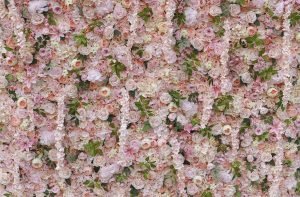
| Full flower wall | Covers most or all of the background | Creates a complete photo surface | Finished size, backing, seams, and stand compatibility |
| Floral arch or open frame | Frames the couple while keeping the venue visible | Uses less floral coverage and can create more depth | Frame shape, cluster positions, and secure attachment points |
| Partial floral installation on panels or draping | Adds flowers to a solid, curved, or fabric background | Allows flowers, signage, color, and texture to be combined | Panel dimensions, mounting surface, and visible gaps |
| Modular flower panels | Coverage can be adjusted for different projects | Damaged sections can be replaced separately | Panel size, connectors, assembly time, and seam visibility |
A full flower wall is useful when the venue background needs to disappear from the final view. An open arch or asymmetrical frame is more suitable when the architecture, scenery, or draping should remain part of the composition. Partial floral clusters work well when the decorator already owns backdrop panels and needs flowers as an interchangeable design layer.
For a more detailed product comparison, see artificial flower walls vs. flower arches. The new project should be selected according to the venue and setup plan, not only according to which format looks fuller in a catalog image.
Measure the Venue and the Camera Frame Before Ordering
Nominal backdrop size and useful visible coverage are not always the same. Flowers may extend beyond the base, while stands, side poles, curves, or hanging fabric may reduce the clean area visible from the front. Ask the supplier whether a quoted measurement refers to the backing, the frame, or the outermost flowers.
Record the following dimensions before requesting a quotation:
- Maximum available width and height
- Ceiling height and any hanging restrictions
- Distance from the backdrop to the couple, table, or stage edge
- Width needed for couple, group, or guest photographs
- Door, elevator, corridor, and loading access
- Floor space available for bases, support legs, and counterweights
- Side clearance for installation and maintenance
A 2.4 × 2.4 m or 8 × 8 ft flower wall is a common event format, but it should not be treated as a universal answer. A small couple-only photo area may need less coverage, while a stage, wide ceremony setup, or group photo area may require a larger or extended design.
If possible, mark the proposed dimensions on a venue photo or floor plan. Then test the composition from the photographer’s expected position. This helps the buyer identify exposed wall edges, narrow camera framing, blocked signage, and undersized floral coverage before production.
Specify the Floral Coverage, Not Just the Overall Size
Two backdrops with the same outer dimensions can use very different amounts of flowers. One may be fully covered, while another may use only two floral clusters on an open frame. A quotation should therefore describe both the structure size and the intended floral coverage.
For a full wall, confirm:
- Backing width and height
- Whether coverage reaches all outer edges
- Flower density and visible gaps at normal viewing distance
- Number and location of seams
- Whether the bottom edge will be hidden by floor flowers or furniture
For an arch, curved panel, or asymmetrical backdrop, describe:
- Total arrangement width
- Highest floral point
- Left and right side extension
- Trailing or hanging length
- Depth from the supporting surface
- Position of each floral cluster on the frame
Do not rely on terms such as “large,” “full,” or “loose asymmetrical arrangement.” Marking the width, highest point, side extension, and trailing length on the reference image gives the supplier clearer production targets. It also makes later size comparisons more meaningful.
Buyers who specifically need a full floral surface can review the separate guide to artificial flower walls for weddings, which covers wall sizes, backing options, flower density, and panel formats in more detail.
Select Flowers for Viewing Distance, Lighting, and Handling
The most expensive flower material is not automatically the best choice for every part of a large backdrop. Material decisions should reflect where the flowers will be placed, how closely they will be photographed, and how often the installation will be handled.
Large background areas are usually viewed from farther away, so overall color balance, shape, density, and depth have a strong effect on the result. Flowers near the couple, sign, or camera may need finer petal detail because they appear in close photographs. Lightweight materials can reduce the load on large or suspended elements, but delicate petals may need more protection during packing.
Color also needs to be reviewed in context. Warm hotel lighting can make cream, champagne, and blush colors look deeper, while cool lighting may make the same backdrop appear paler. Strongly reflective petals can look different under flash photography.
For custom projects, send the supplier a color palette and venue image rather than using only color names. A physical sample or material swatch is useful when an exact color relationship is important.
When comparing flower materials for weight, appearance, and packing requirements, the artificial flower materials guide provides a broader B2B overview.
Confirm the Structure, Installation Method, and Accessories
Artificial flowers cannot be planned separately from the structure that holds them. Before production, the decorator and supplier should confirm whether the order includes only floral pieces or also includes a frame, stand, base, backdrop panel, or other hardware.
Important installation details include:
- Frame shape and exact dimensions
- Attachment points on the frame or panel
- Hooks, sleeves, mesh, fabric loops, clips, ties, or connectors required
- Number of floral sections and their installation order
- Weight and size of each section
- Base footprint and available floor clearance
- Whether the finished backdrop needs front-only or multi-angle coverage
- Tools, ladders, and number of installers expected on site
For outdoor weddings, the event team must assess wind exposure, ground conditions, weather, and the stability of the complete structure. Decorative flowers and a lightweight frame should not be assumed to be secure simply because each part is easy to carry. The final support and counterweight plan should follow venue rules and be checked by the responsible installer.
For hotel and banquet projects, also check loading access, lift size, doorway width, setup hours, and whether frames can be assembled in the room. A visually simple backdrop can still create delays if the largest component cannot pass through the service route.
For a custom backdrop, agree on the approval evidence before packing. Useful checks include a straight-on photograph of the complete setup, side views, close-ups of seams and attachment points, a tape-measure reference for the finished dimensions, and a count of all floral sections and accessories. These checks can reveal a position, color, or coverage mismatch before international shipment.
Plan Packing and Shipping as Part of the Product Design
Wedding backdrops are often lightweight relative to their volume. This means international freight may be calculated by dimensional weight rather than actual weight. Before ordering, ask for the number of cartons, carton dimensions, actual weight, estimated dimensional weight, and packing method.
One UIMI packing example shows why this matters. A 2.4 × 2.4 m fabric-backed flower wall can be divided into two 1.2 × 2.4 m sections and packed into two cartons. In this example, each carton is approximately 60 × 50 × 50 cm with an actual weight of about 12.2 kg. Its dimensional shipping weight may be approximately 25–30 kg per carton, depending on the carrier’s calculation method.
This is a real working example, not a fixed specification for every flower wall. Flower type, density, backing, compression, accessories, and stand inclusion can all change the final package. Buyers should request packing data for the exact SKU or custom design before comparing freight options.
Work backward from the event date when confirming the order schedule. Design approval, color or sample confirmation, production, international transport, customs clearance, unpacking, and a trial installation may all require separate time. Ask the supplier to confirm the schedule for the actual order instead of applying one standard lead time to every backdrop.
The setup schedule should also include unpacking and reshaping time. Label cartons by section and installation sequence, keep small accessories together, and inspect the backdrop before it is sent to the venue. Follow the supplier’s care instructions when restoring compressed petals, and avoid uncontrolled high heat that could damage the material.
Build Backdrops for Reuse, Repair, and Inventory Growth
For a rental company or decorator, a backdrop should be evaluated as inventory rather than as a single-event purchase. A highly specific color combination may suit one booking but be difficult to rent again. A neutral base with detachable accent clusters can support a wider range of wedding themes.
Useful inventory features include:
- Modular sections that fit more than one frame or venue size
- Replaceable flowers, leaves, ties, and small panels
- Clear section labels for faster reassembly
- Storage covers or cartons that protect the finished shape
- A repair kit for minor damage after transport
- Coordinated accent flowers that can also be used on aisles, entrances, or tables
Photograph the complete setup before the first event and record the frame, accessories, installation time, and any adjustments. After each rental, inspect attachment points, backing, flower heads, and exposed areas. This turns maintenance into a repeatable process and makes it easier to decide which parts need repair or replacement.
Decorators building a broader range can explore artificial flowers for wedding decoration and coordinate backdrop colors with arches, aisle arrangements, centerpieces, and other reusable products.
Common Mistakes When Buying Wedding Backdrop Flowers
Ordering from a Reference Photo Alone
A reference image communicates style but rarely confirms size, backside construction, flower quantity, or installation method. Add marked dimensions and a short specification list.
Assuming the Frame or Stand Is Included
Product photos often show a complete event setup, while the quotation may cover only the flowers. Confirm every structural and installation component line by line.
Measuring Only the Empty Wall
Furniture, people, bases, side poles, and camera framing change the usable area. Measure the complete setup zone and review a front elevation or mockup.
Choosing Density Without Considering Distance
Close-up photo areas reveal gaps and attachment points more easily than distant stage backdrops. Review detailed images or a sample at the intended viewing distance.
Comparing Product Price Without Packing Data
Two similarly priced backdrops can have very different carton volumes, assembly requirements, and freight costs. Compare the landed and installed project requirements, not only the unit quotation.
Leaving Installation Decisions Until the Event Day
Unmarked sections, missing ties, unfamiliar frames, and compressed flowers can consume the setup window. Conduct a trial assembly when the design or structure is new.
What to Send a Supplier Before Requesting a Quote
A clear inquiry reduces repeated questions and helps the supplier recommend a suitable format. Include:
- Backdrop use: ceremony, photo area, stage, entrance, or sweetheart table
- Venue type and indoor or outdoor location
- Available width, height, depth, and access restrictions
- Required floral coverage and main viewing angles
- Frame or panel type, including dimensions and photos
- Reference image with marked floral positions
- Color palette and preferred flower types
- Standard product, color adjustment, or custom design requirement
- Whether stands, bases, connectors, or other accessories are needed
- Order quantity and expected reuse purpose
- Destination country and required delivery date
- Packing, carton labeling, or branding requirements
If some details are not yet confirmed, separate them into “confirmed,” “pending,” and “optional.” This lets the supplier prepare an initial recommendation without treating every design idea as a final production instruction.
Final Checklist for Decorators
Before approving artificial flowers for wedding backdrops, check that:
- The backdrop has a defined purpose and viewing distance.
- Venue and camera-frame dimensions have been confirmed.
- Structural size and floral coverage are specified separately.
- The flower colors have been reviewed against venue lighting.
- The frame, stand, bases, and attachment method are clear.
- Indoor access or outdoor stability requirements have been assessed.
- Carton count, dimensions, weight, and unpacking needs are known.
- The product can be stored, repaired, and reused as planned.
- The quotation lists all flowers, hardware, accessories, and custom work.
- A trial assembly is scheduled when the structure or design is unfamiliar.
Artificial flowers for wedding backdrops work best when the design and the operational plan are developed together. By confirming the backdrop’s purpose, visible coverage, dimensions, structure, packing, and reuse requirements before production, decorators can reduce on-site uncertainty and build more practical event inventory.
Planning a wedding backdrop project? Send UIMI your venue dimensions, reference images, frame details, color palette, quantity, and destination. We can help you compare standard flower walls, backdrop arrangements, and custom options for your event business. Request a project quotation.
FAQ
Are artificial flowers suitable for wedding backdrops?
Yes. They can be prepared before the event and used on flower walls, arches, panels, draping, and other backdrop structures. The material and format should match the viewing distance, installation method, and reuse plan.
What is a suitable size for a wedding flower backdrop?
There is no single suitable size for every event. A 2.4 × 2.4 m or 8 × 8 ft wall is common, but the correct size depends on the venue, number of people, camera framing, furniture, and required coverage.
Is a flower wall or floral arch better for a wedding backdrop?
A flower wall provides full background coverage. A floral arch frames the focal area while keeping more of the venue visible. Choose according to the background, photography plan, transport, and setup conditions.
Are backdrop stands normally included with artificial flowers?
Not always. Some quotations cover only floral pieces, while others may include a compatible stand or frame. Confirm the stand, base, connectors, counterweights, and installation accessories separately.
Can wedding backdrop flowers be customized?
Yes. UIMI can confirm custom colors, sizes, flower combinations, arrangement proportions, and selected packaging or branding options according to the design, materials, and quantity required.
What is the minimum order quantity for wedding backdrop flowers?
Selected standard flower walls and wedding arches can start from one piece. Minimum quantities and conditions for custom designs depend on the required color, size, materials, design, and order quantity.