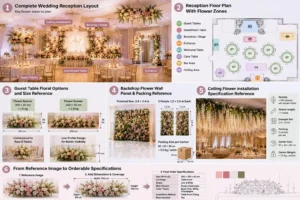
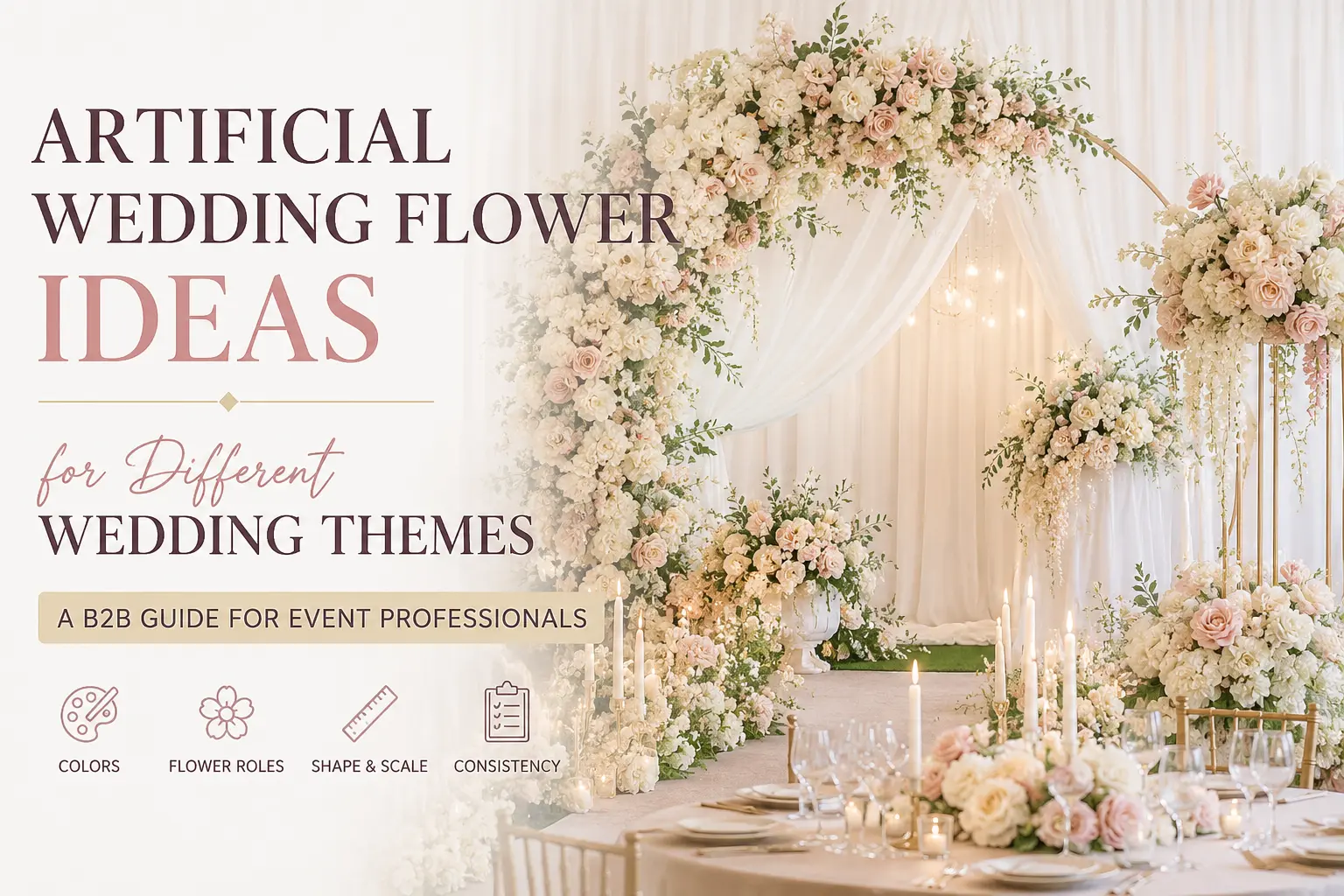
Clients often send mood boards, reference photos, or broad terms such as “romantic,” “boho,” or “modern.” But these ideas still need to be turned into clear purchasing specifications.
Event decorators must define the main colors, flower roles, arrangement shapes, and how arches, walls, centerpieces, and aisle flowers should work together.
For buyers who need a broader overview first, our guide to wholesale artificial wedding flowers covers the main product categories and ordering basics. This article focuses on how to turn one wedding theme into a consistent floral direction across the full event.
Turn a Wedding Theme Into a Clear Floral Specification
Terms like “romantic,” “natural,” or “luxury” are useful starting points, but they are too broad for ordering. Buyers need to turn the theme into clear visual specifications.
Define a Color Hierarchy, Not Just a Color List
Do not simply list pink, white, and green. Confirm which color is dominant, which supports it, and which is only an accent.
Similar shades should also be separated clearly. Pure white, ivory, cream, blush, and champagne can create very different results.
Define the Role of Each Flower
Group the flowers by function:
- focal flowers
- supporting flowers
- fillers
- greenery
- trailing elements
For each item, record the exact product or SKU, approved color, floral role, whether it must repeat across key products, and whether substitution is allowed.
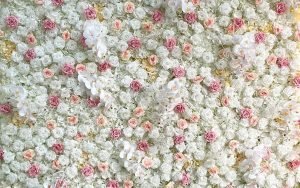
For one romantic wedding collection, the buyer may confirm cream white as the dominant color, blush and dusty pink as supporting tones, and champagne as a limited accent.. The same color hierarchy can then be used across the arch, aisle flowers, and table arrangements.
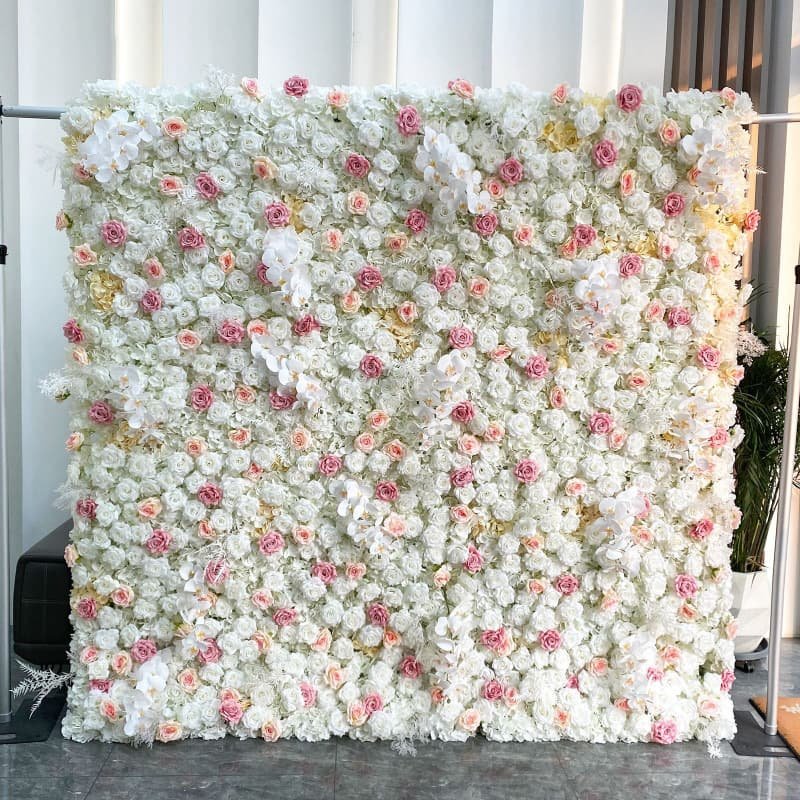
| Theme Element | Approved Specification |
|---|---|
| Theme | Romantic / Classic |
| Dominant color | Cream white |
| Supporting colors | Blush pink and dusty pink |
| Accent color | Champagne |
| Main flower language | Cream-white roses and soft white blooms |
| Accent flowers | Pink roses and white orchid sprays |
| Greenery | Minimal |
| Shape | Dense and evenly distributed |
| Density | High density with minimal visible gaps |
| Viewing direction | Front-facing |
| Must repeat across products | Cream-white base, pink accents, limited champagne tones |
Define Shape With Directions and Measurements
Words such as “loose” or “asymmetric” can be interpreted differently. Confirm:
- highest point
- widest point
- extension direction
- trailing length
- viewing direction
- left or right orientation
This is especially important for one-sided or paired arrangements.
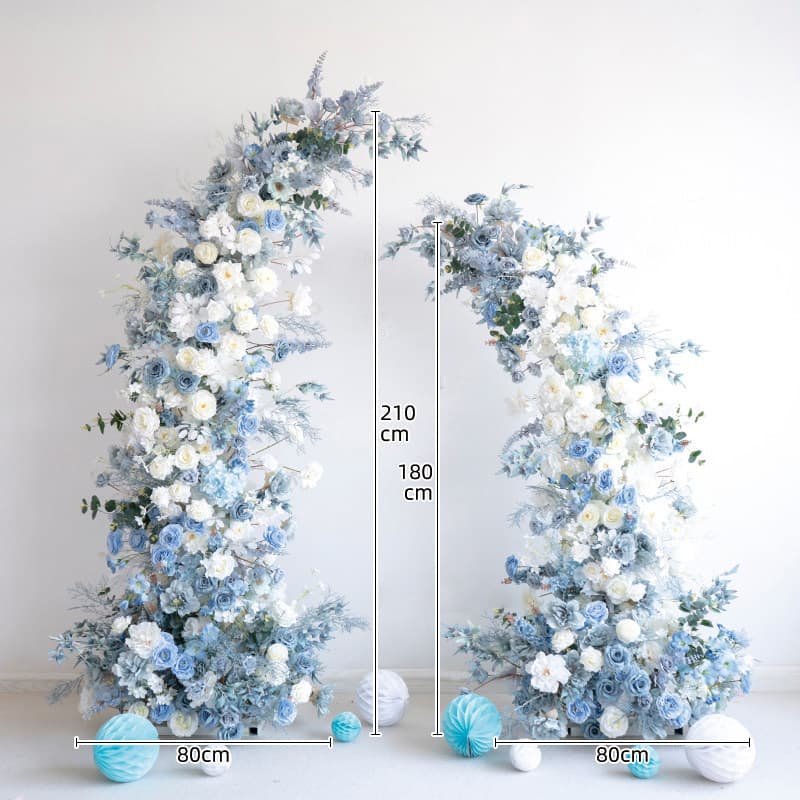
Instead of asking for a “loose asymmetric arch,” a buyer can define the shape with clear measurements. In this example, the two sections are 210 cm and 180 cm high, with an 80 cm base width, creating a clear height difference and open center.
Separate Scale From Density
A large arrangement is not always a dense one.
Confirm scale through:
- height
- width
- depth
- extension
Confirm density through:
- visible gaps
- number of layers
- front coverage
- side coverage
| Theme Element | What the Buyer Should Define |
|---|---|
| Color | Dominant, supporting, and accent colors |
| Flower role | Focal, supporting, filler, or greenery |
| Shape | Round, loose, cascading, or asymmetric |
| Direction | Highest point and extension direction |
| Scale | Height, width, depth, and extension |
| Density | Gaps, layers, and coverage |
| Viewing angle | Front-facing, two-sided, or 360-degree |
Check the Venue Before Finalizing the Flower Direction
A flower style that works in one venue may look very different in another. Before confirming the products, buyers should check the background, lighting, and viewing distance.
Check the Background Color
Flowers need enough contrast with the venue.
A white wall may weaken cream or pale flowers, while a dark wall can make them stand out more. Greenery backgrounds may reduce the impact of green foliage, and gold structures can change how warm colors appear.
Consider the Actual Lighting
Daylight, warm ballroom lighting, evening lighting, and stage lights can all affect color.
Cream, champagne, and pale pink need extra attention because they may look more yellow or muted under warm light.
Match Flower Scale to Viewing Distance
Close-up table arrangements can rely on smaller details.
Aisle flowers need to stay clear from a medium distance, while large focal installations usually need stronger shapes, larger blooms, and clearer color contrast.
Before ordering, ask for:
- venue photos
- background color
- event time
- viewing distance
- installation height
For area-specific planning, see our guides to artificial wedding flowers for ceremony areas and the wedding reception flower checklist.
Build a Master Floral Recipe for the Whole Event
When each product is selected separately, the final setup can look inconsistent. A master floral recipe helps keep the full event visually connected.
Choose the Elements That Must Repeat
Define the main elements that should appear across key products:
- main focal flower
- secondary flower
- accent flower
- greenery family
These repeated elements create a clear visual link between the arch, centerpieces, aisle flowers, and other arrangements.
Decide What Can Change Between Products
Keep the following consistent:
- color palette
- focal flowers
- overall visual direction
Allow changes in:
- scale
- density
- quantity
- arrangement direction
A centerpiece should not copy an arch exactly, but both should still look like part of the same event.
Approve One Benchmark Arrangement
Before confirming all products, approve one reference piece, such as:
- an arch section
- a medium floral module
- a sample arrangement
Use it to confirm:
- color
- flower mix
- density
- greenery
- shape
This piece then becomes the visual reference for the rest of the order.
Map the Master Recipe Across Different Products
| Product | Must Repeat | Can Change |
|---|---|---|
| Flower arch | Focal flowers and palette | Scale and direction |
| Centerpiece | Main flower language | Density |
| Aisle flower | Accent colors and greenery | Quantity |
| Flower wall | Main palette | Minor fillers |
Record Substitution Rules
Separate the flowers into:
- must-match flowers
- flexible supporting flowers
- approved replacement options
A replacement should match not only the color, but also the bloom size, shape, and role in the arrangement.
Romantic and Classic Artificial Wedding Flower Ideas
Romantic and classic themes often use soft colors, but the final result depends on careful tone and scale control.
Control Undertones Before Adding More Flowers
Pure white, ivory, cream, blush, and champagne can look similar in photos but very different when placed together.
Before ordering, review pale colors under the same lighting and confirm which tone should dominate.
Balance Large and Small Blooms
Use larger blooms as focal points and smaller flowers to support the overall shape.
The right balance also depends on viewing distance. Small details work well in centerpieces, while arches and aisle flowers need stronger shapes that remain clear from farther away.
Repeat the Same Visual Identity Across Major Products
The arch, centerpieces, and aisle flowers should repeat the same key colors and focal flowers.
Compare finished product categories together, not one by one. Large arrangements should also be reviewed as complete pieces rather than approved from single-stem photos alone.
Boho Artificial Wedding Flower Ideas: Define Asymmetry Clearly
Boho arrangements often use loose, uneven shapes. For ordering, the direction should be defined clearly instead of using words like “natural” or “wild.”
Define the Main Direction
Confirm whether the arrangement should extend:
- upward
- outward
- downward
- mainly to one side
This helps the supplier understand where the visual weight should sit.
Specify Height and Trailing Length
Confirm the:
- highest point
- side extension
- trailing length
- amount of negative space
These details make the final shape easier to control.
Confirm Left, Right and Mirrored Pieces
For paired arrangements, clarify whether they should be:
- left-facing
- right-facing
- identical
- mirrored
Request front, side, and angled photos before approval, especially for asymmetric pieces.
Rustic and Garden Themes: Control Variety and Substitution
Rustic and garden styles often use more flower types, which makes consistency harder to control. Buyers should define which elements lead the design and which only support it.
Define the Main Flower Families
Separate the arrangement into:
- focal flowers
- supporting flowers
- fillers
- greenery
This makes it easier to keep the same visual structure across different products.
Define the Role of Greenery
Clarify whether greenery is used as:
- background
- structure
- the dominant visual element
Its role should stay clear throughout the project.
Set Substitution Rules Before Production
Define the elements that must match and cannot be changed.
Flexible elements may be replaced within agreed limits. Check any replacement by:
- color
- bloom size
- visual weight
- shape
- floral role
A flower with a similar color may still change the overall look if its size or shape is very different.
Modern and High-Impact Wedding Themes: Control Spacing and Density
Modern and high-impact designs need more precise control because spacing, structure, and density are easy to notice.
Modern Themes Need Precise Negative Space
Control:
- flower spacing
- stem direction
- visible gaps
- structural exposure
In cleaner designs, uneven spacing or exposed structure can quickly affect the final look.
Check Front, Side and Back Views
Confirm:
- visible frames
- connection points
- exposed ties
- side coverage
Do not approve open or asymmetric designs from the front view alone.
High-Impact Themes Need a Density Hierarchy
Separate the project into:
- hero pieces
- supporting installations
- accent pieces
Avoid making every product equally dense. The main focal pieces should carry the strongest visual weight.
Define What “Full” Actually Means
Instead of simply asking for a “fuller” arrangement, confirm:
- visible gaps
- number of flower layers
- front coverage
- side depth
- flower protrusion
These details give the supplier a clearer standard for production.
Final Theme Consistency Check Before Production Approval
Before approving production, review the full floral direction as one system.
- Is the color hierarchy clear?
- Are focal and supporting flowers defined?
- Is the arrangement direction measurable?
- Are scale and density defined separately?
- Is there one approved master floral recipe?
- Which flowers must repeat across products?
- Which flowers may be substituted?
- Are asymmetric pieces left-facing, right-facing, or mirrored?
- Have the venue background and lighting been considered?
- Have all major product categories been reviewed together?
Once the visual specification is approved, buyers can move on to standard checks for quantities, MOQ, packing, and bulk order planning. Use the Artificial Wedding Flower Buying Checklist for Event Businesses for the final order review, then see How to Buy Artificial Wedding Flowers in Bulk for Event Businesses for larger purchasing decisions.
Conclusion
The best artificial wedding flower ideas are easier to source when the theme is turned into clear decisions about color, flower roles, shape, density, and product consistency.
For B2B buyers, the goal is not to choose each arrangement separately. Every floral product should follow the same visual direction and work as part of one complete event design.
UIMI works with wedding planners, event decorators, rental companies, and wholesale buyers on coordinated artificial floral designs for complete event projects. Contact us to discuss your theme, product requirements, or custom floral specifications.
FAQ
How do I turn a wedding theme into clear flower specifications?
Start with the color hierarchy, focal flowers, supporting flowers, arrangement shape, density, and viewing direction. Broad terms such as “romantic” or “boho” are not enough for production.
Should all floral products use exactly the same flowers?
No. The arch, centerpieces, aisle flowers, and flower wall can use different quantities and densities, but the main palette and focal flowers should stay consistent.
How should I approve colors for a wedding flower project?
Compare pale shades such as white, ivory, cream, blush, and champagne under similar lighting. Confirm which color is dominant before approving the full product range.
What should I confirm for asymmetric floral arrangements?
Confirm the highest point, extension direction, trailing length, and whether the piece is left-facing, right-facing, identical, or mirrored.
Can supporting flowers be substituted during production?
Yes, but only within agreed limits. Replacements should match the approved color, bloom size, shape, visual weight, and floral role.